
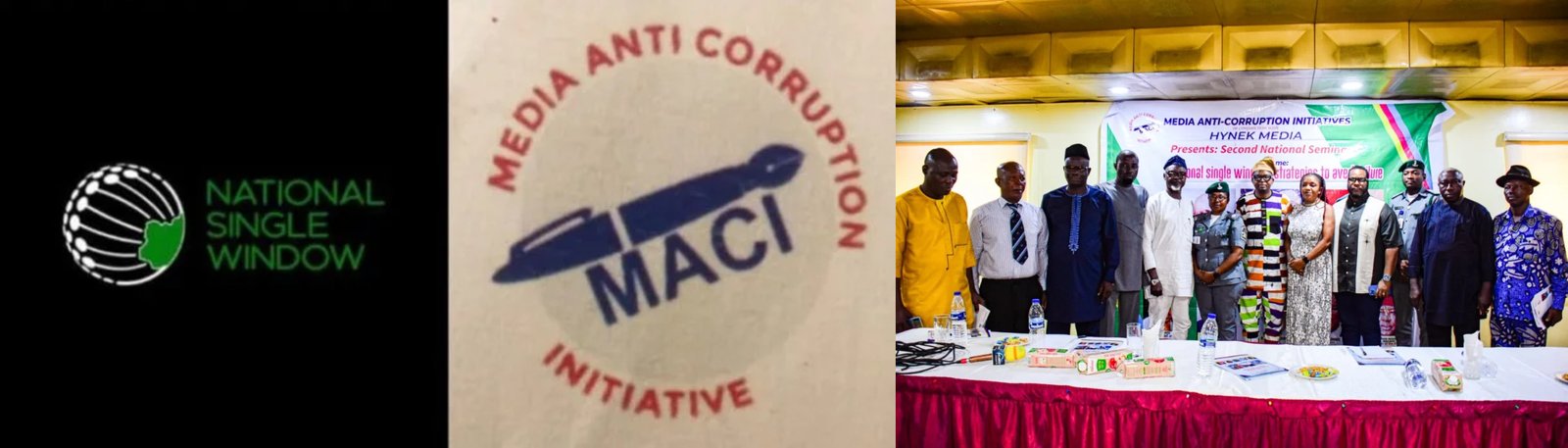
A two-day high-level stakeholders’ seminar organized by the Media Anti-Corruption Initiatives (MACI) in conjunction with Hynek Media was convened in Lagos to examine the theme: “National Single Window: Strategies to Avert Failure.”
The seminar brought together stakeholders from government, maritime agencies, trade facilitation bodies, and the private sector.
Participants acknowledged the National Single Window (NSW) initiative as a critical national reform project designed to streamline trade processes, enhance efficiency at ports, and improve Nigeria’s global competitiveness in import and export operations.
The seminar noted that the NSW has the potential to significantly reduce transaction costs in trade operations by up to 25 percent while improving government revenue generation by approximately 20 percent if effectively implemented.
Stakeholders expressed concern that despite its potential benefits, Nigeria’s reform history shows that major policy initiatives often fail due to weak institutional coordination, lack of transparency, and inter-agency rivalry.
The seminar emphasized that the success of the NSW depends on strong political will, sustained institutional collaboration, and full buy-in from all relevant agencies involved in trade facilitation and border management.
It was agreed that capacity building and continuous training of customs officers, port officials, and regulatory agencies are essential to ensure effective adoption and operation of the National Single Window system.
Participants further stressed the need for a holistic policy framework that integrates all relevant agencies, including customs, shipping, health, environment, and other regulatory bodies, to avoid operational contradictions and administrative delays.
The seminar highlighted the importance of infrastructure readiness, noting that inadequate port facilities, unreliable electricity supply, and weak logistics networks remain major constraints to trade efficiency in Nigeria.
It was resolved that the National Single Window must be supported by robust digital infrastructure, including reliable broadband connectivity, automated systems, and secure data exchange platforms across all participating agencies.
The stakeholders recommended full end-to-end automation and interoperability of the NSW system to ensure seamless processing of trade documents and real-time coordination among relevant institutions.
The seminar called for the establishment of efficient dispute resolution mechanisms within the NSW framework to address operational conflicts, tariff disputes, and regulatory disagreements in a timely manner.
Participants emphasized the need for strong compliance and enforcement systems, including real-time monitoring, audit trails, and penalties for fraudulent practices to safeguard the integrity of the platform.
The use of data analytics was strongly recommended to enhance decision-making, detect revenue leakages, improve security monitoring, and identify patterns of illicit trade activities.
The seminar further advocated for a “one-stop shop” operational model where traders and stakeholders can submit all required documentation through a single unified platform to eliminate duplication and delays.
In conclusion, the seminar reaffirmed that the National Single Window is not merely a technological reform but a strategic economic transformation initiative.
Participants called for sustained commitment from all stakeholders to ensure its successful implementation for national development and prosperity.
*Being excerpts of the communique issued at the end of the Media Anti-corruption Initiatives (MACI) second national seminar on the National Single Window (NSW) which took place on Wednesday, April 15, 2026 at Rockview Hotel, G.R.A, Apapa, Lagos.