
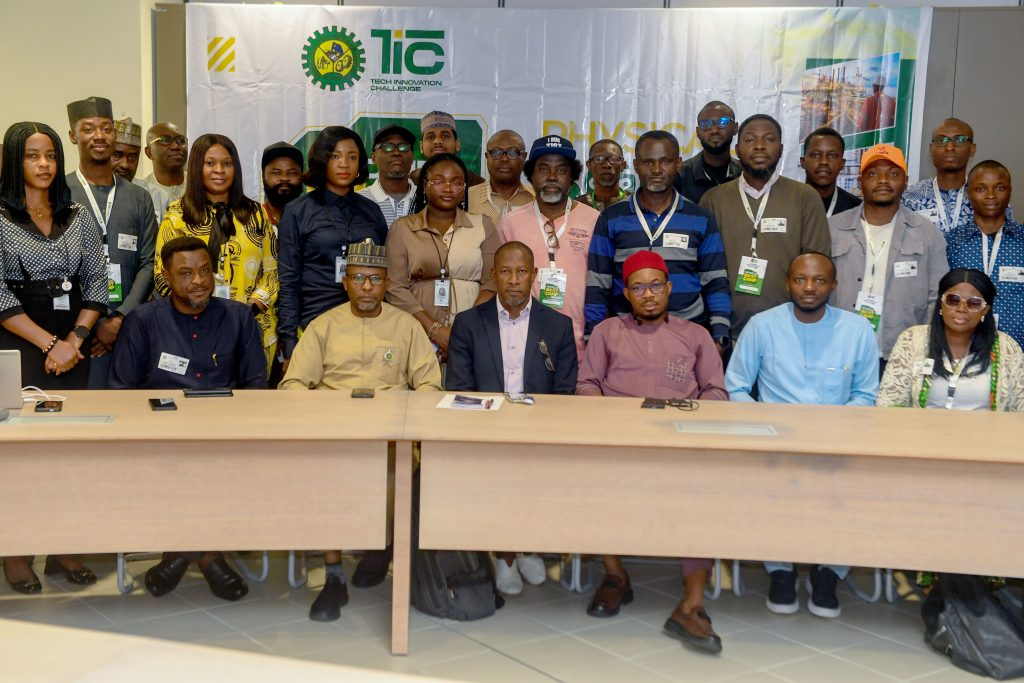
The Nigerian Content Development and Monitoring Board (NCDMB) has unveiled a Technology Innovation Challenge (TIC) 2026 no fewer than 30 innovation teams from tertiary institutions and leading technology firms in the country set to begin a five-day “Entrepreneurship and Research Commercialization Boot Camp.”
The TIC with the theme “Physical Boot Camp: Bridging Research to Commercialization,” was unveiled at the corporate headquarter of NCDMB called the Nigerian Content Tower (NCT), Yenagoa, Bayelsa State.
Maritime Bits checks revealed that the TIC, an initiative of NCDMB, seeks to identify and select indigenous technologies to address key oil and gas industry pen points – operational problems and hazards (both to humans and the environment) – is for appraisal of ‘technology readiness level’ and ‘commercial readiness level,’ among other things.
The Boot Camp is in preparation for the challenge grand finale which holds between 10th and 12th August, when the innovators will be fine tuning their respective solutions, demonstrating to oil and gas industry stakeholders what specific challenges of the sector could now be addressed in-country through indigenous technologies.
In his opening remarks at the event, NCDMB Executive Secretary, Engr. Felix Omatsola Ogbe expressed satisfaction with the originality of ideas exhibited by the innovators.
He noted that the TIC is to encourage participation of indigenous tech firms in the industrialisation of the country and in the production of local technologies that could be globally competitive.
Ogbe who was represented by NCDMB Manager, Facilities and Logistics, Engr. Kamsalem Mohammed said: “You are not lacking in knowledge; you are not lacking in capacity, but you need the tools, you need the guidance through the mentorship (to be provided in the Boot Camp). Most of all, you need the funds.”
He enjoined them to remain focused as they proceed into the next stages of the programme.
NCDMB Research and Development Division (RSDD), Dr. Kingsley Uzor in his remarks said the TIC aligns with the Board’s Nigerian Content 10-Year Strategic Road Map just as he pointed out that it is intended to encourage the participants to be ambitious in their innovations.
According to him, we cannot continue doing the same things over and over again. We have to innovate. The innovators must pay attention to standards that will be accepted internationally while we start from solving local problems. Charity begins at home but it should not end there.
Speaking on the successive stages undergone in the TIC 2026, the consultant, Engr. Chika Chinwah said the 30 innovation teams were selected from an original shortlist of 100 institutions and tech firms. The 30 underwent an online mentorship programme spanning 30 days before the current stage from which 10 teams are expected to proceed to NCDMB’s Technology Innovation and Incubation Centre (TIIC) at the NCT.
Chinwah explained that the TIIC is where “solutions [from the innovation teams] will be incubated to prototype, to MVP [minimum viable product], and for possible IP [intellectual property] licensing for their products, so that they can be put to use in the oil and gas industry.” The end goal of the TIC, he emphasised, is “bridging research to commercialisation.”
He commended the NCDMB for conceptualisation of the TIC programme and for the enormous investments made toward actualising its aims and objectives for the growth of indigenous technologies and the oil and gas industry.
NCDMB TIIC Administrator, Engr. Ghali Jubrilin his remarks noted that the innovators had demonstrated resilience and commitment to innovation.
He assured them that there are top-flight mentors at the centre that would take them through the required mentorship.
The TIC Project Manager, Dr. Obichi Obiajunwa, for his part, explained to the innovators what Technology Readiness Level and Commercial Readiness Level entail as they make their presentations.
In turns, all the innovators stated their respective innovations and what benefits they would bring to the oil and gas industry and the country. Dr. Guiliano Fossong and Professor Kingsley O. Okongwu, said their innovation was PetroEdge AI, an “AI-powered Edge computing software for real-time analysis and interpretation of well log and drilling data at the rig site for hydrocarbon identification and anomaly detection.”
Professor O.M. Adesope of the University of Port Harcourt, and Mr. Chikaike Mbonu of Haimzera whose institutions are in a collaboration, described their innovation as FRASSPLUS, “an AI-enabled low-cost, BSF Frass, green technology for hydrocarbon bioremediation.”
Dr. Omar Umar Ahmed, of Bayero University, Kano, and Dr. Zaharaddeen Sani Gano of National Research Institute for Chemical Technology (NARICT), Zaria, said their organisations are collaborating on “design, development and fabrication of solid oxide electrolysis cell for hydrogen production.”
Others include Professor Iheoma Adekunle, of Federal University, Otuoke, team lead, for a group working on “an indigenous nature-based solution platform that transforms blended invasive aquatic plants into commercially viable high-performance liquid and solid biostimulants.”
Edward Essien Ndiyo of Speedlink Hi-tech Solutions Limited, and his own team have ESS-1000 as their own innovation. He explained that it “transforms portable power into an intelligent field operations platform by integrating energy storage, connectivity, edge computing, real-time gas sensing and AI-driven analytics.”
The Entrepreneurship and Research Commercialisation Bootcamp continues at the NCT and ends on Friday, after which 10 teams would be selected for the grand finale, which holds between 10th and 12th August. The three best teams are to be announced at the finale.