
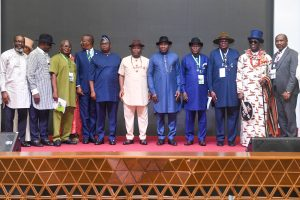
Former President Goodluck Ebele Jonathan has thumbs up Nigerian Content Development and Monitoring Board (NCDMB) for the milestones it has made over the years.
Jonathan who is noted for his humility expressed a sense of fulfilment on the enactment of the Nigerian Oil and Gas Industry Content Development (NOGICD) Act, 2010 and the many benefits that have accrued to Nigeria at the national and community levels since its establishment.
It is on record that it was Jonathan who assent the bill establishing NCDMB into an Act of the parliament during his administration.
Describing NCDMB as an organization that has over time assumed the critical role of business enabler, the former President in a statement made available to Maritime Bits recalled the enthusiasm and promptness with which he signed the NOGICD Bill into law in April 2010.
The statement quoted Jonathan revealing that the inspiration to establish NCDMB came from a visit to China as head of a trade delegation to that country during his days as Deputy Governor of Bayelsa State (December 2005-May 2007).
According to the former Nigerian President, almost everything used in the Chinese oil industry was sourced locally. China became a major global player in oil and gas after the massive discovery of crude oil at the Daqing Oilfield in the North Eastern Heilongjiang Province in 1959, three years after a similar discovery in Otuabagi, Oloibiri District of present-day Ogbia Local Government Area in Bayelsa State.
Jonathan was quoted saying so at the NCDMB corporate headquarters, Nigerian Content Tower (NCT) in the Bayelsa State capital, Yenagoa in his opening address at the Sweet Crude Dialogue 2026 with the theme “Through the Python’s Eye: 70 Years of Oil and Gas Production.”
He revealed that the China experience set him wondering why the case of Nigeria in that sector was so completely different.
According to him, as I returned to Nigeria, I was profoundly upset over the enormous economic losses arising from near-total dependence on foreign expertise, equipment, machinery, production inputs, and technology, among other things.
He lauded NCDMB for its successes and the organisers of the Dialogue, De Mangrove Conversations led by Mr. Biobele Da-Wariboko for the concept and the zeal that had brought them thus far.
Said he: “Bringing people from all walks of life to have a conversation on the oil and gas industry is critical as community issues and state dilemma demand careful attention even as the Petroleum Industry Act (PIA), 2020 has made appreciable impact.”
The Executive Secretary of NCDMB, Engr. Felix Omatsola Ogbe in his remarks noted that the theme of the dialogue provided what he called “a vital vintage point to evaluate our historical journey, analyze our current milestones, and chart an ambitious path for our energy future.”
Ogbe who was represented by NCDMB Director of Monitoring and Evaluation Directorate, Barrister Esueme Dan Kikile commended the former President for decisive action in bringing the NOGICD Act and the NCDMB into reality.
The NCDMB helmsman pointed out that in pursuit of its core mandate – “to supervise, coordinate, and monitor compliance with local content metrics, deliberately building domestic capacities, while ensuring that a significant portion of industry spend is retained in Nigeria” – the Board has grown local content participation to 61 per cent in 2026, up from less than five per cent in 2010.
According to him, the Board’s strict enforcement of its Human Capacity Development Initiative (HCDI) Guidelines has resulted in every major industry project allocating dedicated resources toward training of Nigerian engineers, geologists, technicians, and seafarers, and that its flagship “60-40” graduate training models and global technical certifications to specialize vocational training for host communities has “institutionalized a continuous pipeline of industry-ready professionals.”
On other key projects and accomplishments, both completed and ongoing, Ogbe listed the iconic 17-storey NCDMB Nigerian Content Tower (NCT); Oloibiri Museum and Research Centre (OMRC); Nigerian Oil and Gas Park Scheme (NOGaPS), an industrial park at Emeyal I in Ogbia Local Government Area and another at Odukpani, Cross River State; gas processing infrastructure in the Gbarain hub in Bayelsa State for reliable feedstock distribution to power industrialization in Bayelsa State and Niger Delta region; Polaku Gas Project Footprint, and the Brass Shipyard and Nigeria Liquefied Natural Gas (NLNG) fertilizer project alignment.
Others include the NCDMB Back-to-the-Creek Initiative which is focused on taking development, empowerment, and opportunities directly to the grassroots, where oil and gas activities have the most impact.
According to Ogbe, by anchoring these transformative initiatives, human capital development, and high-level investments” in Bayelsa State, the Board is transitioning the cradle of Nigeria’s oil history from a mere extraction zone into an active centre of commercial, technological, and industrial value retention.
The Bayelsa State Governor, Senator Douyi Diri in his goodwill message stated that for a gathering to examine 70 years of the oil and gas industry in Nigeria, there could not have been a better place for the event than where it all began, that is, Bayelsa State territory.
Diri who was represented by his deputy, Dr. Peter Akpe commended De Mangrove Conversations, the organisers whom he described as distinguished writers, researchers, and professionals of the Niger Delta.
The Delta State Governor, Elder Sheriff Oborevwori who was represented by his Chief of Staff, Prince Johnson Erijo challenged all stakeholders to strive at all times to fulfill public expectations.
He stated that as evaluation of progress in the oil and gas industry was being undertaken, there was need for leaders to renew their commitment to host communities.
The Managing Director of the Niger Delta Development Commission (NDDC), Dr. Samuel Ogbuku represented by his Chief of Staff, Mr. Julius Oworibo said the dialogue should remind the audience “where we are coming from, where we are now – [achievements and benefits that have accrued to oil-and gas-producing communities] – and where we are striving to be.”
In a keynote address, Professor Ibibia Lucky Worika of the Centre of Advanced Law Research at Rivers State University, Port Harcourt, observed that for 70 years “oil has defined our economy, influenced our politics, shaped our foreign relations, financed our development, fuelled conflicts, inspired innovations, and transformed our place in the global energy landscape.”
He pointed out that the Niger Delta region has borne the burden of oil and gas exploitation for 70 years and that “entire ecosystems [have] suffered irreversible damage.”
Given that background, Worika asserted that “environmental justice is not an optional policy aspiration; it is a constitutional, moral and developmental imperative.”
The convener of De Mangrove Conversations, Mr. Biobele Da-Wariboko had earlier in a welcome address said the group emerged out of the need “to ensure that Niger Delta’s enormous resources and contributions to Nigeria’s development are not swept into historical oblivion by the swift currents of ethno-religious and hegemonic politics ravaging our nation’s polity.”