
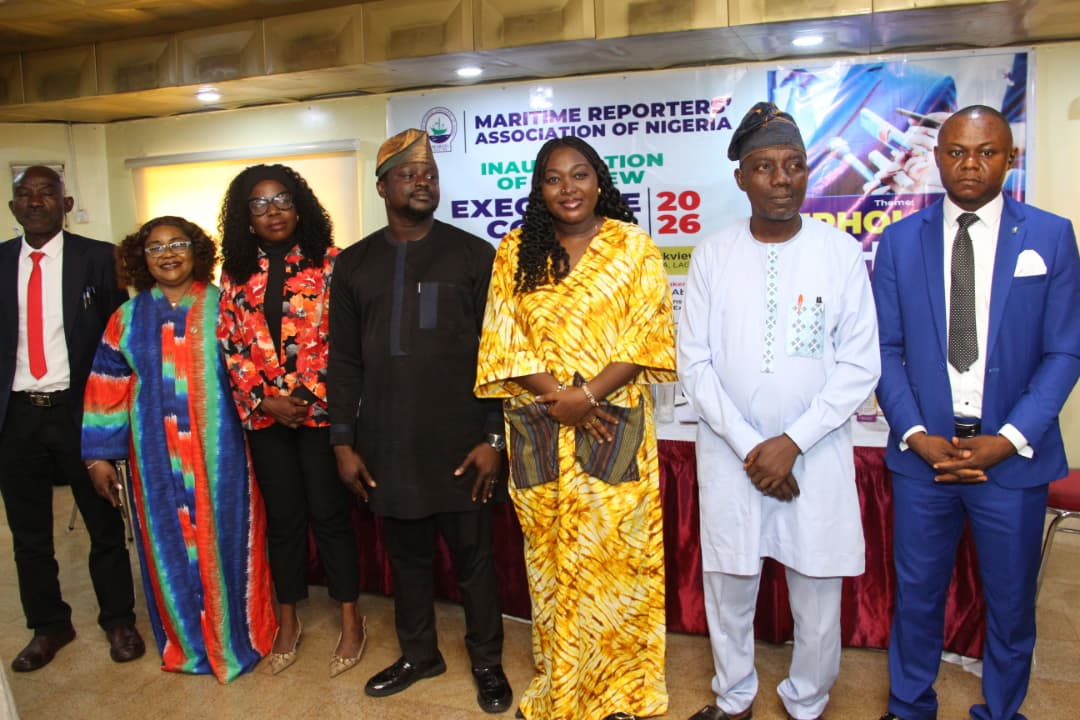
Following the formal inauguration of the newly elected executives of the Maritime Reporters Association of Nigeria (MARAN), stakeholders in the maritime sector of the economy have stressed the need for ethical journalism.
They averred that transparency, accountability, security, and sustainable development remain the only way to drive the growth of the maritime industry.
To this end, they charged maritime journalists to remain committed to professionalism and responsible reporting of the sector in the discharge of their statutory roles and responsibilities.
The stakeholders made the call Tuesday in Lagos during the inauguration of the MARAN newly elected executives led by Mr. Oluyinka Onigbinde.
The event with the theme “Upholding Ethical Journalism for Maritime Development”, brought together maritime industry leaders, government officials, security agencies, freight forwarders, and media practitioners.
The Chief Executive Officer (CEO), Indigo Integrated, Mr. Bolaji Abimbola in his keynote address, described journalism as the backbone of accountability, public trust, and informed citizenship.
While stressing that ethical reporting remains indispensable to both national and maritime development, he explained that maritime development encompasses shipping, port operations, fisheries, offshore energy, coastal trade, and the blue economy.
He warned that unethical journalism could undermine investor confidence, distort public perception, and hinder policy implementation.
Abimbola argued that inaccurate reports on issues such as port congestion, piracy, and maritime regulations have the potential to discourage investors and shipping operators.
He pointed out that sensational reporting of security incidents could trigger unnecessary panic and misconceptions about the sector.
While enjoining journalists to uphold the principles of truth, fairness, balance, accountability, and humanity in their reporting, he also asked to embrace data-driven and investigative journalism to deepen public understanding of maritime issues.
He also identified economic pressures, political interference, safety concerns, and the proliferation of misinformation on digital platforms as some of the major challenges confronting ethical journalism in Nigeria.
The President of the Maritime Security Providers Association of Nigeria (MASPAN), Mr. Emmanuel Maiguwa in his remarks as the chairman of the occasion, emphasized the importance of ethical and investigative journalism in promoting transparency, accountability, and good governance within the maritime industry.
According to him, journalists have a critical responsibility to remain committed to factual reporting and continuous professional development in order to maintain public trust and contribute meaningfully to policy reforms and sectoral growth.
Onigbinde had earlier in his welcome address pledged to build what he called a “stronger, more united, and professionally vibrant” association capable of responding to the evolving demands of maritime journalism.
While describing MARAN as one of Nigeria’s oldest and most respected maritime journalism bodies, he noted that the association has consistently served as a bridge between industry stakeholders and the public through decades of reforms, economic shifts, and industry transformation.
The MARAN President noted that ethical journalism remains fundamental to maritime development because sustainable growth in the sector depends on credible information, transparency, and accountability.
Said he: “As maritime journalists, our duty goes beyond reporting events. We are expected to inform, educate, investigate, analyse and hold institutions accountable. We must resist sensationalism, reject misinformation and ensure that every report we publish is guided by truth, fairness, balance and professionalism”.
He used the occasion to outline the priorities of his administration. These include enhanced capacity building, promotion of investigative and data-driven journalism, adoption of digital reporting tools, improved welfare for members, and stronger engagement with industry stakeholders while maintaining editorial independence.
According to him, unity among members is key. The association had moved beyond electoral divisions. The elections are behind us. There are no longer camps. There are no factions. There is only one MARAN.
The National President, National Association of Government Approved Freight Forwarders (NAGAFF), Chief Tochukwu Emmanuel Ezisi in his goodwill message described ethical journalism as a stabilizing force capable of strengthening the maritime sector.
Ezisi who spoke through NAGAFF General Secretary, Mr. Godfrey Nwosu noted that responsible journalism promotes transparency in port operations, enhances institutional accountability, boosts investor confidence, and supports reforms necessary for the growth of the industry.
He enjoined the newly inaugurated executive council to focus on upholding professional standards, strengthening investigative reporting, deepening stakeholder engagement, embracing digital transformation, and investing in continuous capacity development.
He also reaffirmed NAGAFF’s commitment to collaborating with MARAN in the areas of training, research, information sharing, and advocacy.
The Commissioner of Police, Ports Authority Police (Western) Command, CP Toyin Agbaminoja in her goodwill message at the event, highlighted the strategic role of maritime journalists in promoting transparency, accountability, and public understanding of issues affecting the maritime industry.
Agbaminoja who was represented by the Command’s Public Relations Officer, ASP Isaac Hundeyin commended MARAN for its professionalism in reporting security-related developments within the ports environment.
The Police Chief noted that the association’s work has contributed significantly to crime prevention awareness and strengthened public confidence in security agencies.
Agbaminoja assured stakeholders of the command’s commitment to maintaining a safe, secure, and business-friendly port environment through intelligence-led policing, proactive stakeholder engagement, and enhanced inter-agency collaboration.
She encouraged the newly inaugurated executives to build on the achievements of their predecessors and uphold the highest standards of ethics, professionalism, and integrity throughout their tenure.
The event ended with renewed commitments from stakeholders to support ethical journalism as a vital instrument for maritime development, institutional accountability, economic growth, and the advancement of Nigeria’s blue economy.