
Stakeholders in the maritime sector of the economy have identified high port charges, ageing infrastructure, inadequate digital integration and negative attitudes among port users and operators as the major obstacles to the competitiveness of Nigerian ports.
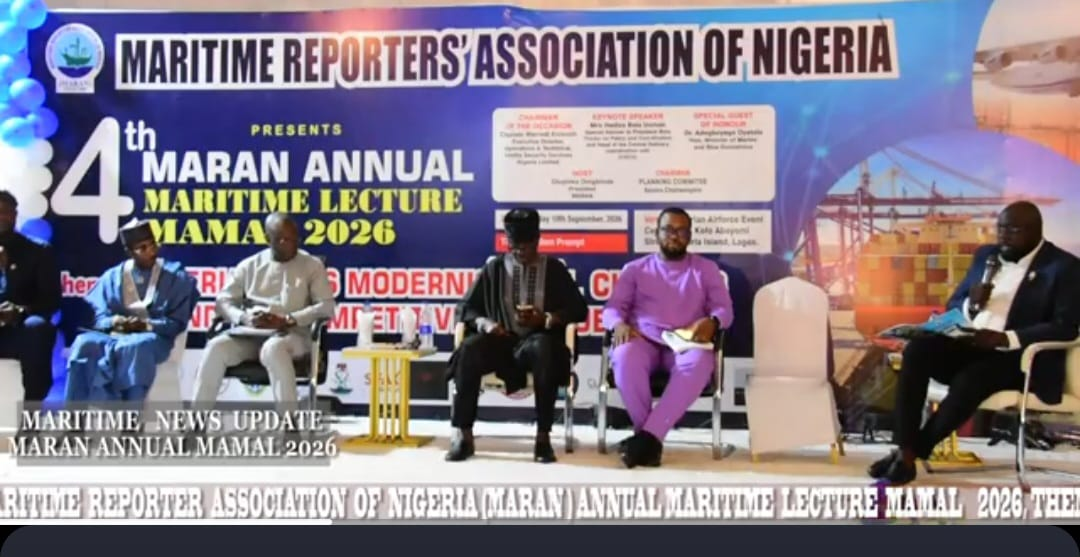
The stakeholders who spoke at the 2026 edition of the Maritime Reporters Association of Nigeria (MARAN) annual maritime lecture (MAMAL) which took place at the Nigerian Air Force (NAF) Events Centre, Victoria Island, Lagos recently opined that these issues need to be address headlong in order to get the desired results.
MAMAL which is in its 4th edition with the theme “Nigerian Ports Modernization, Charges and the Competitiveness Question” was organized by MARAN which remains the umbrella association for journalists covering the maritime industry.
One of the stakeholders and panelists, Mr. Emmanuel Maigunwa said port competitiveness should go beyond reducing the cost of importing and exporting goods to positioning Nigeria as a major regional trade and transit corridor in the West and Central Africa Sub-regions.
Maigunwa who moderated the panel session, noted that efficient and competitively priced ports would ultimately reduce the burden on citizens, while enabling Nigeria to attract cargoes from neighbouring countries and derive greater economic benefits from its strategic maritime position.
On his part, Mr. Willem Inya who represented the Nigerian Association of Chambers of Commerce, Industry, Mines and Agriculture (NACCIMA) on the panel, said the multiplicity of port charges remained a major concern for private-sector operators.
According to Inya, importers are often compelled to pay several charges while trying to clear their containers. This usually results in delays resulting in additional demurrage that further increases the cost of doing business in the country.
As a way out, he called for the harmonization and rationalization of port charges even as he stressed that high and multiple charges could make Nigerian businesses uncompetitive.
In his contribution, Assistant General Manager AGM), Corporate and Strategic Planning, Nigerian Ports Authority (NPA), Mr. Joseph Adegbite identified ageing port infrastructure as one of the biggest challenges to efficient port operations.
The AGM explained that most Nigerian ports, apart from the Lekki Deep Seaport Port, were more than 50 years old, making infrastructure renewal critical to improving port productivity and efficiency.
According to Adegbite, deteriorating infrastructure limits the type of cargo-handling equipment that can be deployed at the ports, thereby affecting productivity and increasing the time vessels and cargoes spend within the port system.
He averred that every inefficiency in port operations ultimately translates into additional costs for port users and the final consumers.
He stated the Federal Government’s ongoing port modernization programme, which is beginning with the ports situated in Lagos State because of its dominant share of the country’s maritime traffic, would subsequently extend to the ones situated in the Eastern part of the country.
Adegbite however stressed that modernization must go beyond physical infrastructure to include digital integration, renewable energy, port community systems and a maritime single window.
His words: “Port operation is a communal system. It is a community. The different agencies and stakeholders must be digitally integrated to eliminate operational silos and reduce delays.”
He also identified infrastructure challenges at several ports, including the Rivers and Warri ports, while noting that Onne Port also requires significant infrastructure improvements.
The Founder and Chief Executive Officer (CEO), Le Look Limited, Chief (Mrs.) Chinwe Ezenwa in her contribution, argued that infrastructure alone would not solve Nigeria’s port problems.
Ezenwa who was the erstwhile Acting Managing Director of National Inland Waterways Authority (NIWA) insisted that the mindset and attitude of stakeholders in the maritime sector of the economy and beyond must change.
According to her, in order to get the desired results, they must embrace change in the way and manner they do their business.
Making her inputs from the floor, she called for deliberate sensitization and reorientation of port users, practitioners and other stakeholders to protect public infrastructure and promote responsible conduct.
She stated that she had witnessed situations where government infrastructure was vandalized, stressing that investments in infrastructure would be a waste if Nigerians did not develop the right attitude towards public assets.
The Le Look Limited CEO called for sustained public enlightenment and a renewed value system as part of the measures required to make port modernization successful.
Captain Ladi Olubowale of African Ship Owners Association in his remarks, warned that the impact of high charges and tariffs could divert cargoes from Nigerian ports to the ones situated in neighbouring countries.
According to him, such cargoes could subsequently be moved into Nigeria through land borders at additional cost, thereby fuelling inflation and increasing the burden on consumers.
He also linked high port charges to the growth of smuggling, arguing that excessive costs could undermine the Federal Government’s efforts to expand the Nigerian economy.
He said Nigeria’s ambition of building a one-trillion-dollar economy by 2030 would require efficient ports with competitive and harmonised charges that support both importers and exporters.
The stakeholders therefore called for a coordinated approach to port reform involving infrastructure renewal, digitalization, transparent and harmonized charges, stakeholder sensitization and improved operational efficiency.
They stressed that Nigeria’s strategic location and vast maritime potentials could only translate into economic growth if its ports were made efficient, competitive and attractive to cargo owners and regional traders.
The panel session formed part of activities at MAMAL 2026 which remains MARAN’s flagship annual programme.
It is on record that MAMAL has over the years serves a rallying point which brings together policymakers, regulators, industry operators, academics, journalists and other stakeholders to examine the challenges and opportunities surrounding the modernization and competitiveness of Nigerian ports.