
*Seeks Downward Review of War Risk Insurance Premium
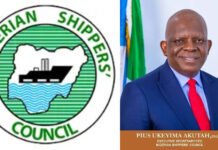
The Executive Secretary, Nigerian Shipper’s Council (NSC), Mr. Pius Akutah has reiterated the resolve of the council to protect the interest of Nigerian shippers in line with its mandate as Nigeria’s ports economic regulator.
Akutah also called for the downward review or outright removal of the current war risk insurance premium surcharge on vessels coming into the nation’s waters.
He stated this in his goodwill message to the third Maritime Reporters Association (MARAN) Annual Maritime Lecture (MAMAL) which took place recently at Four Points by Sheraton Hotel, Victoria Island, Lagos.
The lecture with the theme “Addressing the Burden of War Risk Insurance on Nigeria’s Maritime Trade” was organised by the umbrella body of journalists covering the maritime sector of the economy, MARAN.
Represented by NSC Director, Regulatory Affairs, Mrs. Margaret Ogbonna, the NSC helmsman noted that in recent years, Nigeria through the concerted efforts by the management of the Nigerian Maritime Administration and Safety Agency (NIMASA) and the Nigerian Navy, as strategic partners in regional and international borders, have recorded significant reductions in piracy and armed robbery attacks at sea.
He argued that with these strides as well as the efforts of the maritime industry, ably led by Minister of Marine and Blue Economy, Alhaji Adegboyega Oyetola and NIMASA, strides have been made to ensure that those things are out of the nation’s waters as it was giving the nation negative image across the globe.
According to him, it was as a result of the sustained investments in the maritime domain awareness, improved inter – agency cooperation, deployment of the deep blue project that have resulted in Nigeria’s fair commitment to uphold the safety and security in the maritime environment.
He noted that despite these giant strides Nigeria remains unfairly classified as a high risk shipping zone, thereby attracting exorbitant war risk insurance premium surcharge.
He argued that forcing Nigerian importers and exporters to pay so much money when so much money is needed by the people, in form of war risk insurance is not what can be ignored further noting that these costs have ultimately been transferred to the businessmen hence the reason behind inflating the prices of goods and undermining the competitiveness of maritime trade.
He explained that NSC as the economy regulator remains a strong advocate for the protection of the shippers’ interest just as he added that the council would consistently campaign for the review downwards or outright removal of the war risk insurance surcharge.
Akutah maintained NSC firm belief that the continued imposition of the surcharges which are no longer justifiable, given the improved security matrix and Nigeria’s demonstrable commitment to safe shipping.
He expressed optimism that based on a report reaching him, efforts are being made towards a robust engagement with the international underwriter, Lloyds Marketers Association and local counterparts to advocate a data driven re – assessment of the risk status of the Nigerian waters.
He also reiterated NSC plan to engage with NIMASA and the other agencies, to compile and present an empirical evidence that really reflects the current security reality in the nation’s maritime domain.
According to him, NSC fully supports the ongoing discussions at the ECOWAS, the Gulf of Guinea Maritime Collaboration Forum and at the International Maritime Organisation, (IMO) platforms, all aimed at securing the recognition of Nigeria’s achievements and the need for a fairer treatment by the global shipping and insurance community.
He however admitted that he recognised the fact that addressing these challenges requires constant collaboration between the government, private sector, media and the international partners hence applauding MARAN for the initiative.
The NSC boss affirmed the fact that the council would not relent in its advocacy for the removal or downward review of the war risk insurance premium surcharge hence his promise to stand firmly with the Nigerian shippers and all ports users, in ensuring that the costs of doing business in the nation’s seaports reflect the reality not outdated perceptions.
He also reiterating NSC commitment towards building a cost efficient, secure and competitive maritime sector that supports the Nigeria economic growth and trade development.
He commended MARAN for its unwavering dedication to the growth of the nation’s maritime industry over the years.
Pioneer President of Ship Owners Association of Nigeria (SOAN), Engr. Greg Ogbeifun had earlier in opening remarks as the chairman of the occasion narrated series of his experience and contributions towards the growth of the sector.
He noted that it was time that all participants in lecture to establish a platform to participate in the carriage of the nation’s import and export goods rather than just merely talking about it.
Ogbeifun who is also the Chairman of Starzs Investments Company Limited also spoke about his retirement from active service in the sector but was excited by the establishment of the Ministry of Marine and Blue Economy hence coming back to continue his invaluable contributions.
He appealed that the event should not be tailored towards the usual “talk shop” but should be one with measurable achievements in which by next time when MARAAN would reconvene, there would be a statistics on the status of the war risk insurance issue on the nation’s maritime domain.
According to him, at least by achieving either five or ten percent of the objectives, there will be collaboration with relevant organs to effectively see what needed to be done so as to achieve it. I am therefore soliciting for the untiring support of all the experts in the house to help MARAN and ensure that some measurable milestones are achieved.
The former Director General of NIMASA, Mr. Temisan Omatseye expressed dissatisfaction that the Joint War Risk Committee (JWRC) in London charges a zero point two five percent on every vessel that gets five degrees East of the Lagos harbour which means that, anytime a vessel enters the area towards Delta, Port Harcourt or Bakassi, there is a fee being charged and that fee goes up to zero point six five percent whilst in Pakistan, where there is serious attacks, only zero point two five percent is charged.
He explained that the reason for this was the fact that Nigeria had lost her eyes on the ball just as he noted that for now, Nigeria is the centre of attractions to the world with the Dangote Refinery producing thousand barrels daily, the BUA Refinery, plus other modular refineries which would produce for exports purposes.
According to the former NIMASA helmsman, Nigeria is going to be the next exporter of petroleum products to the world hence the need to adequately find lasting solution to the lingering issues of war risk insurance premium on Nigerian importers and exporters.
The Director General of NIMASA, Dr. Dayo Mobereola in his goodwill message commended MARAN for bringing the topical issue to the fore, as it has become a problem bothering on national security and trade policies.
Represented by NIMASA Deputy Director, Reformed Coordinator Deep Blue Economy, Mr. Victor Iloh, he explained that Nigeria’s statutory geographical position in the Gulf of Guinea exposes her to maritime insecurity, driven by piracy, armed robbery attacks and geographical conflicts, leading to the imposition of war risk insurance premium.
According to him, significant progress has however been made in securing the nation’s maritime domain with no recorded incident in the last four years. This has been attributed to Nigeria’s integrated maritime architecture known as “The Deep Blue Project”, which was inaugurated in 2021 and the deployment of maritime assets on both land, sea, and air. He also explained that the deployment of intelligence to secure the Nigerian waters which also led to the enactment of the Suppression of Piracy and other related Maritime Offences “SPROMO Act” in 2019 and since 2020 with two major convictions of pirates secured in the Federal High Court.
According to Mobereola, Nigeria maritime security safety led to her being delisted by the International Maritime Bureau (IMB) from the list of piracy prone zones in 2021 and the commendations of the International Maritime Organisation (IMO) re-enforced the achievements.
He also stated that the IMB Forum removed Nigeria’s name as a high risk maritime zone in 2023 while constant collaboration with other maritime regional bodies, had contributed significantly towards reducing piracy in the Gulf of Guinea waters.
MAMAL 2025 also featured a panel discussion on the way forward to reducing or removing the vexed issue of war risk insurance premium surcharge on Nigerian bound vessels and was well attended by the industry experts and stakeholders in the maritime industry.