

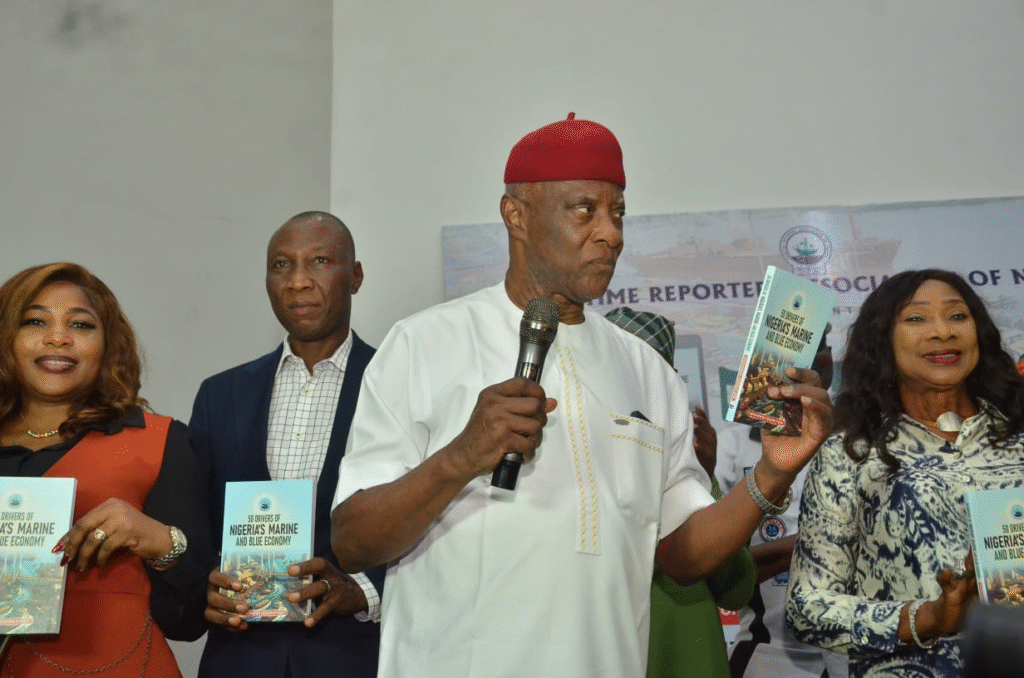
The Nigerian maritime industry took a bold step into the future in Lagos recently as stakeholders converged for the formal unveiling of the book titled “Fifty Drivers of the Nigerian Maritime and Blue Economy.”
Presiding over the event as Chairman, Captain Emmanuel Ihenacho described the gathering as a defining moment for a sector he said remains one of Nigeria’s most powerful but underutilised economic engines.
Ihenacho who was the Minister of Interior during President Goodluck Jonathan’s administration noted that the maritime industry continues to play a central role in trade facilitation, job creation and national revenue generation, stressing that its true potential is only beginning to unfold.
He stated that the title of the book was crafted to spotlight the institutions, policies, innovations and personalities shaping the present and future of Nigeria’s marine and blue economy.
According to the erstwhile minister, in the course of the engagement, attention would be focused on port modernisation, infrastructure development, maritime security and environmental sustainability.
Tracing the sector’s history, he recalled landmark milestones such as the establishment of the Nigerian National Shipping Line (NNSL) in 1959, the Nigerian Maritime Authority (NMA) in 1988 and the birth of the Nigerian Maritime Administration and Safety Agency (NIMASA) in 2007.
He also identified the Cabotage Act as a defining policy shift that strengthened indigenous participation in coastal shipping and maritime commerce.
Beyond local reforms, the chairman drew attention to Nigeria’s growing relevance within global maritime and trade frameworks.
Ihenacho highlighted the Maritime Silk Road as a major pillar of China’s Belt and Road Initiative designed to strengthen connectivity, infrastructure and maritime trade across regions.
He maintained that Nigeria’s entry into the China–Nigeria Economic Corridor in 2016 has already opened doors to fresh investment flows in infrastructure, energy and logistics.
On the continental front, he described the African Continental Free Trade Area (AfCFTA) as a historic economic game changer for Nigeria and the wider African economy.