
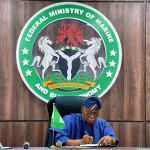
The Minister of Marine and Blue Economy, Alhaji Adegboyega Oyetola has enumerated his achievements since his appointment by President Bola Ahmed Tinubu as a member of the Federal Executive Council (FEC) and the creation of the ministry two years ago by the present administration.
He also called for the immediate review and removal of war risk insurance premiums imposed on Nigerian-bound vessels henceforth.
Describing the surcharge as outdated, unjust, and detrimental to the nation’s economic competitiveness, he averred that Nigeria has earned the right to be delisted from global maritime high-risk classifications.
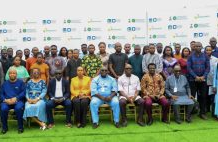
Oyetola stated this at the third annual maritime lecture organized by the Maritime Reporters Association of Nigeria (MARAN) at Four Points by Sheraton, Victoria Island, Lagos recently.
The Minister who was represented by his Special Adviser on Media and Communications, Dr. Bolaji Akinola said that in just two years Nigeria’s maritime landscape has witnessed what he called “profound reforms” including the ending of the decades-long Apapa gridlock that had crippled port productivity and discouraged foreign investments over the years.
Other achievements include the launch of Africa’s first national policy on Marine and Blue Economy, a groundbreaking framework that provides a roadmap for shipping, fisheries, offshore energy, aquaculture, tourism, and maritime services.
He also announced that FEC had approved the modernisation of Lagos and Tin Can Island Ports with plans for the Eastern Ports nearing completion.
According to Oyetola who has served as the pioneer minister of the newly created Ministry since 2023, agency-generated revenues more than doubled within two years, from ₦700.79 billion in 2023 to ₦1.39 trillion in 2024, the highest in Nigeria’s maritime history.
The minister added that the long-stalled Cabotage Vessel Financing Fund (CVFF) had finally been unlocked to empower indigenous ship owners while a National Flag Carrier Technical Committee had been inaugurated to deliver a private-sector-led national shipping line that would restore Nigeria’s pride in global shipping.
Oyetola who was hitherto the governor of Osun State pointed to the progress in boosting local fish production to strengthen food security, supporting aquaculture in riverine communities, and reforming inland waterway safety through new regulations, improved patrols, search and rescue coordination, and stricter passenger vessel standards.
He expressed regret that despite these achievements, Nigeria continues to bear the burden of war risk insurance premiums imposed by international underwriters just as observed that these charges, based on outdated perceptions of insecurity, have cost the nation an estimated $1.5 billion in the last few years.
He stressed that Nigeria’s narrative of piracy and armed robbery on its waters no longer reflects present realities.
According to him, over the past four years, Nigeria has recorded zero piracy incidents due to sustained investments in maritime security, particularly through the Deep Blue Project.
The Deep Blue Project, implemented by the Nigerian Maritime Administration and Safety Agency (NIMASA) in partnership with the Nigerian Navy, integrates air, land, and sea assets to deliver real-time surveillance and interdiction. The success of this initiative has been acknowledged globally, earning Nigeria commendations from the International Maritime Organization (IMO), the International Maritime Bureau (IMB), and removal from the International Bargaining Forum’s list of high-risk nations.
He explained that key global insurers, especially Lloyd’s of London, remain reluctant to update their risk classifications, leaving Nigeria and its consumers to shoulder unfair costs.
He assured stakeholders in the maritime sector of the economy that his Ministry, working closely with NIMASA, is engaging directly with BIMCO, the International Chamber of Shipping, and Lloyd’s, presenting empirical data to demonstrate Nigeria’s security progress.
“Alongside this diplomatic push, the government would continue to strengthen maritime security architecture, publish regular security reports, deepen regional cooperation under the Yaoundé Architecture for Maritime Security, and promote the development of local maritime insurance to retain value within Nigeria’s economy.
He expressed optimism that the future of Nigeria’s blue economy remains bright just as stressed that in just two years, the country has shown what is possible with vision, determination, and partnership.
He added that much more lies ahead even as he reaffirmed the government’s commitment to securing Nigeria’s waters, modernising its ports, empowering local operators, expanding fisheries, and ensuring that the blue economy becomes a pillar of growth, jobs, and sustainability for generations to come.
The minister enjoined participants at the annual lecture tagged MAMAL 2025 to contribute their recommendations which he said would enrich government policy and strengthen strategies for the collective advancement of Nigeria’s maritime sector.