

The Federal Ministry of Marine and Blue Economy has partnered with the National Institute for Policy and Strategic Studies (NIPSS) to accelerate national fish production and close Nigeria’s estimated 2.2 million metric ton supply gap through a coordinated policy roadmap.
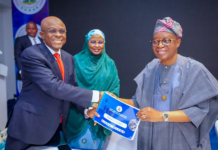
Speaking at the opening of a two-day round table discussion on accelerating national fish production in Lagos, recently the Minister of Marine and Blue Economy, Dr. Adegboyega Oyetola, said the collaboration with NIPSS marks a critical step in implementing President Bola Tinubu’s Renewed Hope Agenda, which prioritises food security, job creation, and economic diversification.
His words: “Current output meets only about 38.9 per cent of the 3.6 million metric tons of fish required annually. This leaves a deficit of over 2.2 million metric tons, forcing Nigeria to rely heavily on imports. This trend is unsustainable — economically, nutritionally, and environmentally.”
The Special Adviser to the Honourable Minister, Dr. Bolaji Akinola in a statement made available to Maritime Bits quoted Oyetola saying that the round table aims to produce a national fish production acceleration roadmap that will guide strategic investments and reforms in the fisheries and aquaculture subsector.

According to the statement, Oyetola who was the former governor of Osun State noted that new policies and legal frameworks, including the fisheries bill and the national fisheries and aquaculture policy, are being developed to strengthen sustainability and governance.
He also highlighted digital reforms within the Ministry, including the automation of fisheries operations and the establishment of a Blue Data Bank in partnership with the World Bank’s PROBLUE Programme.
He said initiatives such as the Green Money Project are already empowering youth and women to engage in aquaculture through input support and training.
Director-General of NIPSS, Professor Ayo Omotayo, reaffirmed the Institute’s commitment to supporting evidence-based policymaking that can help Nigeria achieve fish self-sufficiency. He said NIPSS would continue to work with the ministry to translate the outcomes of the round table into actionable strategies.
The two-day forum, which has experts, operators and other stakeholders in attendance, is expected to generate recommendations that will inform national policy and investment decisions aimed at boosting fish production, reducing imports, and promoting sustainable growth within Nigeria’s blue economy.