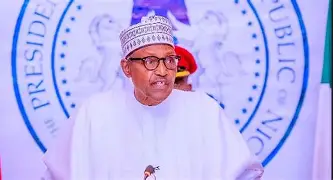
Some stakeholders in the maritime sector of the economy have enumerated the impact the late former President Muhammadu Buhari made during the eight years tenure of his administration.
Those who spoke include the Special Adviser to the Minister of Marine and Blue Economy, Dr. Bolaji Akinola and the President of the Master Mariners Association of Nigeria (MMAN), Captain Tajudeen Alao.
Akinola stated that Nigerians will remember Buhari for what he called “his enduring impact” in the maritime sector of the economy.
The Minister’s aide who stated this in an interview with the News Agency of Nigeria (NAN) in Lagos said that Buhari’s enduring impact in the maritime sector marked a turning point in the nation’s journey toward maritime security and global competitiveness.
His words: “With the passing of President Muhammadu Buhari on Sunday, July 13, Nigeria bids farewell not only to a statesman and former Head of State but also to a leader whose deep and enduring impact was felt in the maritime sector.
“At a time when Nigeria’s waters were ranked among the most dangerous in the world, President Buhari took bold and unprecedented steps to reverse that tide. Under his administration, Nigeria launched the deep blue project, a multi-billion-naira integrated maritime security architecture designed to tackle piracy, sea robbery, and illegal activities in the Gulf of Guinea.
“This initiative, backed by aerial surveillance and an advanced command-and-control center, contributed directly to the decline of piracy incidents in waterways, thereby restoring investor confidence and securing Nigeria’s role as a maritime hub in West Africa. The late President Buhari also signed into law the Suppression of Piracy and Other Maritime Offences Act (2019), making Nigeria the first country in West Africa with a dedicated anti-piracy legal framework.”
Akinola noted that the late President’s tenure saw the realisation of one of Nigeria’s most ambitious infrastructure projects, such as the Lekki deep seaport which was commissioned in 2023.
He noted that the facilities at Lekki deep seaport had transformed Nigeria’s capacity for cargo handling, reduced vessel waiting times, and created hundreds of jobs.
He emphasised that Buhari championed the development of inland dry ports in Kaduna, Kano, and other locations, following his understanding that the port system was not as strong as its connectivity.
Akinola averred that the inland facilities brought maritime services to the doorstep of the hinterland, reducing congestion in Lagos and cutting transport costs for millions of businesses.
“Buhari understood that for Nigeria to thrive economically, its maritime sector could no longer be a sleeping giant, which made the maritime agenda results-driven, focused not on applause, but on outcome.
“The former President’s contributions to our waterways, our ports, and maritime institutions will echo through time, not just in the pages of policy, but in the movement of goods, the safety of seafarers, and the strength of a maritime nation he rebuilt.
“May Almighty Allah forgive his shortcomings, accept his good deeds, and grant him Al-Jannah Firdaus. Ameen,” he added.
On his part, the MMAN President stated that Buhari introduced the unprecedented deep blue project.
According to Alao, this helped in drastically reducing piracy in our Exclusive Economic Zone (EEZ) and the Gulf of Guinea. The reduction in piracy in the Gulf of Guinea had led the international maritime industry to applaud Nigeria’s efforts. 24-hour port operation was reintroduced during Buhari’s regime.
He also stated that the sleeping Maritime Academy of Nigeria (MAN), Oron, Akwa Ibom State was reawakened in terms of infrastructural and rated the best maritime academy in Africa, a remarkable feat after 40 years of decay.
Continuing, he said: “The unpaid entitlements of government retirees from organisations like the National Shipping Line, Nigerian Airways, Nigeria Telecommunications Ltd. (NITEL), Nigeria Ports Authority (NPA), National Electric Power Authority (NEPA), and so on were promptly budgeted and paid. Retirees were put on a permanent payroll. Ease of doing business was introduced at the ports. An anti-corruption task force was also introduced at the ports during President Buhari’s regime.
According to the Master Mariner, it was during President Buhari’s regime that the Petroleum Industry Bill (PIB) was signed into law and the Nigerian National Petroleum Corporation (NNPC) conglomerate was privatised into many companies.
Alao who is also a board member of the National Inland Waterways Authority (NIWA), however, said that the scarcity of forex affected the import-based economy and reduced business activities at the ports.