
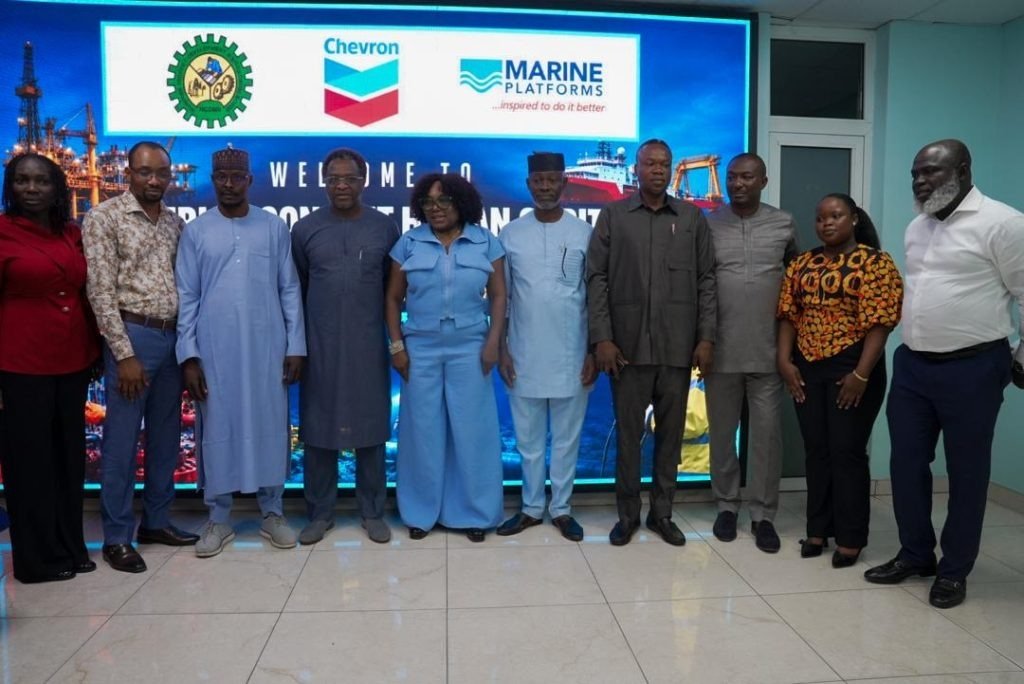
As part of efforts to develop specialized skills and increase Nigerian participation in the oil and gas industry, the Nigerian Content Development and Monitoring Board (NCDMB) in collaboration with Chevron Nigeria Limited (CNL) and Marine Platforms Limited (MPL) has commenced a 12-month Human Capacity Development (HCD) training programme in subsea engineering for 50 selected Nigerian graduates.
The programme which was formally launched at a kick-off ceremony in Lagos recently, focuses on the provision of a subsea intervention vessel under subsea engineering, one of NCDMB top 10 field-readiness training skill areas.
Maritime Bits checks revealed that is designed to equip participants with the technical knowledge, practical experience and professional competencies required to work in the specialized subsea sector.
The training comprises six months of intensive classroom instruction and six months of structured on-the-job training. Participants will be exposed to subsea engineering fundamentals, health, safety and environmental procedures, subsea structures, offshore operations, installation activities and remotely operated vehicle (ROV) familiarization.
NCDMB General Manager, Human Capacity Development Initiatives, Ms. Alexis Emelle said the programme was an investment in developing local capacity, increasing Nigerian participation in the oil and gas industry and contributing to national development.
She described subsea engineering as a technically demanding field requiring precision, safety consciousness and strict adherence to operational standards.
Emelle said the 50 beneficiaries were selected from 150 candidates who participated in the selection tests, urging them to demonstrate commitment, discipline and willingness to learn throughout the programme.
The General Manager added that the training would develop their technical knowledge, practical experience, problem-solving skills, teamwork and commitment to safety.
“The industry needs people who can demonstrate competence in practice, not just knowledge in theory,” she said.
While expressing appreciation to CNL for its partnership and commitment to developing Nigerian talents, Emelle also commended MPL for undertaking the delivery of the specialized training programme.
Emelle enjoined participants to maintain punctuality, discipline, integrity, accountability and respect for safety procedures, noting that their ability to demonstrate competence in practice would be important to their professional growth.
MPL Chief Administration and Integrator Services Officer of Marine Platforms Limited, Mr. Baji Nyam in his remarks, said the programme was part of the company’s efforts to give back to NCDMB with which it had maintained a longstanding relationship.
Nyam said MPL had worked with NCDMB since Nigerian Content was still an initiative operating from the NNPC Towers in Abuja, adding that the company had also made contributions to the development of the Nigerian Content Act.
According to him, MPL had developed capacity in the area of materials but recognized the shortage of specialized human capacity within the industry, making the development of skilled personnel necessary.
He explained that the subsea sector operates in a global environment where skilled professionals can move between countries, making it important for Nigerian companies to develop, retain and remunerate qualified personnel adequately.
Nyam warned that failure to do so could force companies to rely on foreign professionals to undertake work for which Nigerians had already been trained.
While calling on other companies to join MPL, NCDMB and international oil companies in developing the workforce needed by the industry, he stated that the training was structured to combine classroom instruction with practical exposure to actual project activities.
The MPL Chief revealed that participants would take part in mobilizations and demobilizations for offshore construction work as part of their training.
He also revealed that facilitators would be drawn from CNL, other organisations, universities and international partners, some of whom would be brought in to take participants through different stages of project delivery, from engineering to the final delivery of jobs.
The programme presentation outlined the training phases, beginning with induction, health, safety and environmental procedures, worksite exposure and subsea fundamentals. The technical component will cover subsea structures, design and installation, offshore pipelines, construction, subsea operations planning, mobilization planning, hydrographic surveys, lifting and rigging design, vessel motion analysis and engineering material selection.
According to him, participants will also receive training in engineering software and applications, including AutoCAD, Mathcad, Excel and SolidWorks, as well as subsea pipeline integrity management, engineering codes and standards, project planning, offshore operations and professional communication. The programme will involve international engineering organizations and specialists, including PDI, a UK-based engineering company, which is expected to provide training in some specialized areas.
In his remarks, MPL General Manager, Engineering and Projects, Mr. Taiwo Olusami said participants would undergo all the training areas before choosing their preferred specialization.
Olusami added that the programme would prepare them for employment opportunities with other subsea contractors, including roles currently handled by expatriates, and equip them to seek jobs internationally.
Speaking on behalf of CNL, its Manager, Monitoring and Evaluation, Mr. Jolomi Okirika said the company was committed to supporting the development of Nigerian capacity in areas where expatriates were undertaking jobs Nigerians could be trained to perform.
He said the training was intended to equip participants with skills for opportunities within Nigeria and beyond the continent.
Okirika said the programme required significant financial commitment and urged participants to demonstrate corresponding dedication by giving their time and effort to the training.
“If we are committing funds, we need you to commit your time and your efforts,” he said, adding that participants would be assessed for international certifications and would be required to pass the relevant examinations, as attendance alone would not guarantee certification.
NCDMB Senior Supervisor, Human Capacity Development, Brainye Ameikumi, described subsea engineering as a specialized skill area, adding that MPL was the only company offering the training in Nigeria and across Africa.
He said the programme was expected to produce 50 graduates who would become ROV pilot technicians within the next 12 months, noting that there was a significant gap in the availability of such technicians in the industry.
Speaking on behalf of the beneficiaries, Uyoyo Eya said the programme offered an opportunity to acquire specialized engineering knowledge that was not readily available through conventional university education or online learning platforms.
Eya who has a background in civil engineering, said she hoped to gain technical knowledge in handling subsea structures, including manifolds and flow lines, as well as the design, construction and installation of subsea systems.
Another participant, Joshua Ekeoku, expressed appreciation for the opportunity, describing the training as important to developing local competence in subsea engineering.
The programme also provided laptops to participants as work tools, which were made available by CNL. Participants were also assigned personal protective equipment (PPE).
CNL Capacity Development Advisor, Mr. Inyere Victor in his remarks commended MPL and NCDMB for their contributions, describing the training as a joint commitment by the three organisations to building capacity for the country. He expressed confidence in Marine Platforms’ ability to deliver the specialized programme.
Victor enjoined participants to demonstrate humility, character, discipline, commitment and focus throughout the training.
He said stakeholders would reconvene for the programme’s close-out ceremony after 12 months and expressed hope that participants who excelled would secure employment opportunities.