
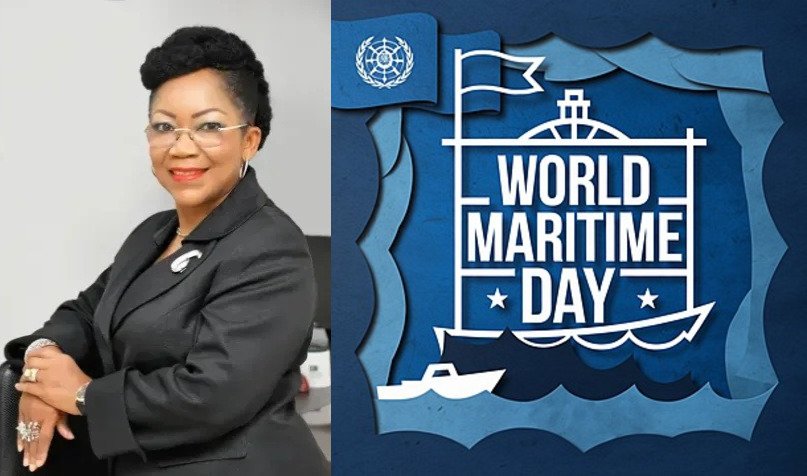
By Mfon Ekong Usoro
I am delighted to be among friends and grateful to the Ministry for creating this opportunity to exchange ideas, assess our accomplishments, and consider how we can improve the delivery of the Blue Economy’s identified strategic initiatives and programmes. We commend the International Maritime Organization (IMO) for shifting the emphasis from policies and regulations to action, implementation, and the delivery of real, tangible benefits to “seafarers, port personnel, ship operators, and maritime administrators”.
While the IMO sub-theme, “Empowering Maritime Excellence”, focuses on the maritime sector, our theme for this year’s celebration, From Policy to Practice: Strengthening Nigeria’s Blue Economy, adopts a broader perspective that reflects our peculiar institutional arrangements while maintaining the same emphasis on delivery. Our invitation to speak suggests we should not merely recount official milestones or repeat claims of completed implementation. Instead, we should examine and comment on measurable improvements for businesses and communities.
Ultimately, an efficiently managed Blue Economy must ensure the sustainable use of our blue economy resources, support sustainable economic development and wealth creation, and improve the livelihoods of Nigerians.
The first step was to find a home for the Blue Economy in Nigeria. The creation of the Ministry of Marine and Blue Economy in 2023 by His Excellency, the President, marked that milestone. The next foundational step was to develop a national Blue Economy policy, approved by the Federal Executive Council and presented to the public in 2025, with a ten-year implementation horizon. The National Policy defines Nigeria’s Blue Economy as “a holistic and sustainable approach to harnessing the potential of oceans, coastal and inland waters, living and non-living things for economic growth, ecological conservation, and societal development.
This national policy document on marine and blue economy delineates Nigeria’s marine and blue economy as all economic activities on or related to Nigeria’s maritime domain. This includes offshore waters, offshore islands, estuaries, lagoons, archipelagos, deltas, wetlands, creeks, coral reefs, mangrove forests, sandy beaches and dunes, as well as inland waterways such as lakes, rivers, falls, and streams” (National Policy on Marine and Blue Economy, 2025, p. 1, 2). This comprehensive definition combines the World Bank’s emphasis on ocean health, restoration and regeneration of aquatic and marine ecosystems; the European Union’s recognition of a wide range of interlinked established and emerging sectors; UNECA’s inclusion of coasts, lakes, rivers and underground water; and UNDP’s focus for Small Island States on areas such as blue biotechnology, ocean tourism and energy. By drawing these strands together, the Policy document localizes the concept for Nigeria: the Blue Economy is not limited to states bordering the Atlantic Ocean or possessing wetlands, mangroves, estuaries, lagoons and deltas; it encompasses aquatic and marine ecosystems across the federation, including rivers, lakes and dunes.
With the two foundational milestones achieved, Nigeria has entered the delivery phase, beginning in 2026. The task now is to strengthen what has been established and to put the remaining enabling pillars in place. The Policy identifies five Blue Economy sectors: 1) Maritime Trade and Transportation; 2) Fisheries and Aquaculture; 3) Marine Resources and Industries; 4) Energy and Environmental Sustainability; and 5) Blue Tourism and Recreation, each supported by strategic initiatives, projects and programmes. The central question is whether these aspirations are being translated into measurable progress.
Have the Policy’s building blocks been established? Who is tracking performance against the identified indicators, and can stakeholders access that information? Implementation will inevitably present challenges, some of which were not anticipated; an equally important question is how those challenges are beingidentified and addressed.
This leads me to a specific proposal, which I invite my colleagues to develop further: Nigeria should establish, or strengthen if one already exists, an INTEGRATED BLUE ECONOMY ECOSYSTEM FRAMEWORK to support the transition from policy to practice. An integrated Blue Economy ecosystem recognizes the interdependencies and complementarities among relevant ministries and agencies across all three tiers of government, from policy formulation through to implementation. The Policy acknowledges the need for inclusivity, but more practical guidance is required on operationalising these structures. For example, it establishes a Policy Advisory Council and notes private-sector participation, but unlike its treatment of the subnational Coordination Committee and regional and international stakeholders, where members are identified, it provides little detail on the Council’s membership.
The Council is assigned a crucial role under the chairmanship of the Honourable Minister of Marine and Blue Economy, yet it remains unclear whether it is intended to operate at ministerial level. An effective Blue Economy governance framework should expressly establish a multi-ministerial coordinating body in its policy document. This approach promotes joint ownership from the outset, demonstrates a commitment to collaboration, supports a participatory, ecosystem-based approach, and facilitates translating policy into practice. The critical members of the Policy Advisory Council should be named in the policy document, which at a minimum should include the Federal Ministers responsible for Transport, Finance, Petroleum Resources, Environment, Budget and Economic Planning, Defence, Solid Minerals, Science and Technology, Education, and Agriculture and Rural Development; and heads of institutions such as the Maritime Academy of Nigeria; the Central Bank of Nigeria; commercial banks; and commissioners from strategic state government ministries, reflecting the constitutional powers and responsibilities of state governments with regard to Blue Economy-related functions. Experts from the above establishments must be at the drawing table to jointly develop implementation strategies and delivery plans, achieve shared ownership of the goals and clearly defined tasks, and commit to delivery.
Implementing the statutory mandate set out in sections 36 and 37 of the NIMASA Act underscores the need for an institutionalised, coordinated ecosystem implementation strategy. These sections require the Ministry of Marine and Blue Economy and NIMASA to operationalise non-tariff incentives for eligible Nigerian shipping companies granted national-carrier status, to support indigenous ship owners and grow Nigerian-flagged oceangoing tonnage. Eligible companies are guaranteed exclusive rights to carry imports and exports of government cargo generated by the Federal Government, states, local governments and public-private partnerships; at least 50 per cent of bulk dry and liquid cargo; and 50 per cent of technical-aid and international-aid cargo. NIMASA is also required to develop an efficient strategy for the international carriage of crude oil and petroleum products by Nigerian-flagged vessels – this relates to FOB and CIF trade terms. The truth be told, neither NIMASA nor the Ministry can fulfil this mandate alone. Implementation requires coordinated action by the Ministries responsible for Budget and Economic Planning, Finance, Trade and Industry, Petroleum Resources, Justice, and Marine and Blue Economy; the Central Bank of Nigeria; NIPC, NEPC, CAC and NCDMB; the Nigerian Navy, Nigeria Customs Service, FIRS and the Immigration Service; all MDAs that generate project cargo; and relevant agencies of the aforementioned Ministries.
What is Nigeria’s position on port logistics performance indicators and the liner shipping connectivity index? Available statistics indicate that we are not doing well. Yet a nation’s score across the factors assessed in evaluations of port logistics performance, liner shipping connectivity, and reputational risk is directly linked to ship registry attractiveness and competitiveness, as these factors influence ship owners’ commercial decisions on flag choice. An increase in the number of Nigerian-flagged cabotage vessels does not count towards determining whether a ship registry is attractive, as it is driven by mandatory provision rather than ship owners’ free decisions.
Within the Ministry of Marine and Blue Economy, NIMASA therefore cannot treat inefficient port logistics as solely NPA’s responsibility, just as NPA cannot treat the growth of nationally owned tonnage as solely NIMASA’s responsibility.
Similarly, improving port logistics performance indicators and the liner shipping connectivity index depends on the performance of multiple Ministries and Agencies outside the Ministry of Marine and Blue Economy’s sphere of influence. The major challenge, from my perspective and, I believe, shared by most stakeholders, is that Nigeria’s Blue Economy aspirations do not yet appear to be shared national goals, as the relevant MDAs have not, for example, adopted growth in Nigerian tonnage in international seaborne trade and high scores in port logistics performance as national priorities in which they must play a part.
I commend NIMASA for what appears to be a return to its core mandate as a flag State administration, which derives from its UNCLOS-backed right to grant ships Nigerian nationality (the right to fly a Nigerian flag) through a ship registry. We have begun to hear words like competitive, competent ship registration again. I privately send the DG a thumbs-up whenever I read about such initiatives. A highly professionalized Ministry, with well-skilled personnel in the right roles and with the right competencies, is a sine qua non for a supervising Ministry for the Blue Economy.
Transforming Nigeria’s Blue Economy from a framework of policies, laws, and regulations into measurable achievements requires coordinated strategies that address these broader operating-environment challenges.
The interdependencies and complementarities among MDAs mean that progress in one area can drive progress across other Blue Economy sectors and subsectors. Nigeria therefore needs a WHOLE-OF-GOVERNMENT approach that assigns shared responsibility, coordinates implementation, and tracks measurable results. That is how robust policies can be translated into practice and the Blue Economy’s central promises can be realised: environmental sustainability, economic growth for businesses and communities, and improved livelihoods for every Nigerian.
Once again, I thank His Excellency, the Hon. Minister, and his powerful team for this opportunity.
Long live the International Maritime Organization!
Long live the Federal Ministry of Marine and Blue Economy!
Long live Nigeria’s Blue Economy!
*Being excerpts of the keynote address presented by the pioneer Director General, Nigerian Maritime Administration and Safety Agency (NIMASA), Mrs. Mfon Ekong Usoro at Nigeria’s celebration of the 2026 World Maritime Day at Lagos Continental Hotel, Victoria Island, Lagos…recently.
16 October 2026
Keynote Address
Mfon Ekong Usoro
Partner, Paul Usoro & Co.
Protocols