

John Iwori writes that the poor narratives of Idiroko Border Corridor in Ogun State is changing for the better under the Acting Customs Area Controller (CAC), Deputy Comptroller Oladapo Afeni’s watch.
The Nigeria Customs Service (NCS) has several roles and responsibilities in the execution of the fiscal policies of the Federal Government. These roles and responsibilities are clearly cut out in its enabling law, the NCS Act 2023.
Nevertheless, its core mandate remains revenue generation, anti-smuggling and trade facilitation. In fact, the NCS remains a key government agency. It is the fulcrum of the Federal Government fiscal policies implementation.
This not unconnected with the fact that it is the agency saddled with the responsibility of enforcing the Import Prohibition List (IPL) and the Export Prohibition List (EPL) drawn up by the Federal Government based on its economic policies. Indeed, it is a veritable revenue spinner for the Federal Government over the years. However, it is also a para-military organization.
In the execution of its mandate, especially in the area of suppression of smuggling, it is more pronounced in the border corridors across the country. This is not unconnected with the fact that illicit cross border trade is rampant among some unpatriotic elements who have made it their way of life.
However, the NCS has not rested on its oars as it has continued to embark on measures to ensure that smugglers do not have a field day. Maritime Bits checks revealed that the service has changed its methods and strategies in recent times so that it will be one step ahead of those who have taken smuggling as a way of life in the border corridors across the country. A case in point is the Ogun I Area Command which has its operational headquarters in Idiroko.
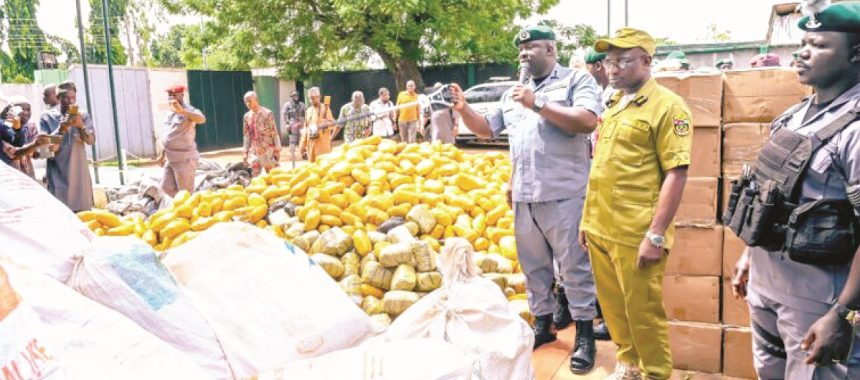
NCS has stepped up its game in tackling the illicit trade in the border community and its environs. For instance, in the last 41 days alone, men and officers of NCS, Ogun I Area Command intercepted contraband valued at N6.77 billion. Among other things, the seizure comprises narcotics, foreign rice, expired food items, petroleum products, and counterfeit medicines.
To say the least, the seizures showed what some stakeholders in the maritime industry described as “an entrenched illegal economy” thriving along Nigeria’s border with other neighbouring countries, especially the Republic of Benin.
In a bid to stand up to the challenge, the NCS Ogun 1 Area Command which has
Deputy Comptroller Oladapo Afeni as its Acting Customs Area Controller (CAC) has bared its fangs. The efforts of the command have made it to be one of the most aggressive anti-smuggling NCS formations in the country in recent times. The Customs Chief was very emphatic in his assertion that the strides made by officers and men in the command was not a flash in the pan.
Afeni affirmed that the figures are not just enforcement statistics as they represent what he called “a calculated attempt to dismantle a complex smuggling ecosystem” that has long flourished under the cover of geography, demand gaps, and weak cross-border control mechanisms over the years.
An Operational Area Like No Other
The operational jurisdiction of the Ogun 1 Area Command is not like any other Customs formation. Its operational headquarter, Idiroko is unique in so many ways. There is a major road linking it to other parts of the state as well as the Republic of Benin and beyond. Besides this major road are numerous other ones that are unknown to the uninitiated. There are also several bush paths in the thick forest that is between Nigeria and the Republic of Benin. The people of the two countries also have similarity in language and culture. Over the years, they have inter-married as some natives have family members and relatives in both countries. They also trade among themselves in the colonial and post-colonial era. This socio-economic relationship between the people of both countries is often exploited by smugglers in the execution of their illicit trade, particularly in the export and import of goods listed in the EPL and the IPL.
Maritime Bits checks revealed that Afeni’s emergence as the Acting CAC, Ogun I Area Command has changed the narrative of the Idiroko corridor as there is presently a noticeable tightening of enforcement measures. Afeni revealed that officers and men of the command recorded no fewer than 73 seizures within a month. Not a few stakeholders in the maritime industry have opined that the figure reflects both operational intensity and the scale of smuggling activity in the areas under the purview of the command.
Recurring Items in Smuggling Ring
Items often smuggled into Nigeria through neighbouring countries are many. However, some of these items have becoming a recurring decimal in every interception and seizures by officers and men of the NCS, Ogun 1 Area Command. They include no fewer than 10,126 parcels of cannabis indica which is popularly known as “Ghana Loud”. The illicit drug weighing 4,627 kilogrammes is not less than N5 billion in the drug market. It is on record that cannabis remains the most dominant illicit commodity moving through the Idiroko axis, feeding a growing domestic drug consumption market and an increasingly violent criminal ecosystem that goes beyond Nigeria’s shores.
The Acting CAC revealed that from January 2026 to date, his officers and men have seized more than 26,000 parcels of cannabis sativa and indica combined.
Afeni’s words: “This is not merely a policing success. It is an evidence of a deeply embedded supply chain stretching across West Africa and the Central Africa Sub-regions. This is not just a seizure. It is a preventive measure. Without this intervention, our society would face a wave of drug-related crises that our already overstretched healthcare and rehabilitation systems cannot manage.”
The Customs Chief’s submission is not standing alone as not a few stakeholders, especially security experts have opined that the magnitude of drug trafficking in Nigeria’s borders reflects the operational sophistication of transnational criminal syndicates. They averred that in many instances, these groups exploit Nigeria’s porous borders and high domestic demand for prohibited items as enumerated in the EPL and IPL.
They maintained that there is a nexus in the increase in illicit drugs trafficking to the rising cases of criminality in the country, particularly cultism, armed robbery, kidnapping and terrorism. This is not unconnected with the fact that smuggling is no more seen as an isolated criminality but a step in a long chain of activities involving several persons and huge sum of money in several countries in the West and Central Africa Sub-regions and beyond.
Number One Item in the Smuggling Ring
Maritime Bits checks revealed that the number one item in the smuggling ring besides illicit drugs is foreign parboil rice. This is understandable. Rice is a stable food in many homes in Nigeria and beyond. Hence it is in high demand especially during the festive seasons. This is what attracts smugglers to go the extra miles in smuggling it to Nigeria through the land borders.
According to Afeni, not less than 1,759 bags of foreign parboiled rice was intercepted and seized by officers and men of the command recently. This is in spite of the provisions of the EPL and IPL. In addition to the provisions in the EPL and IPL, there is a Federal Government policy which forbids the importation of rice into Nigeria by land. In other words, no one is permitted to bring in rice into the country through any of its land borders. Therefore, the importation of foreign rice into the country through its borders is a clear violation of the laws of the land.
The reasons for the Federal Government policy on rice importation through the land borders are not farfetched. Apart from creating employment opportunities for her teaming population involved in local production of locally grown rice, it grows the economy and provides sustainable food security. It is one of the factors responsible for NCS aggressive measures to ensure that smugglers and other criminal elements do not advertently and inadvertently thwart the purpose for which these policies were enacted in the first place.
According to Afeni, smuggling and criminalities undermine national economic goals and cannot be allowed to continue. Rice is a staple food eaten in many homes in the country. Its importation through the land borders was prohibited by the Federal Government to encourage local production and self-sufficiency.
Petroleum Products, Others After Rice
It is on record that after rice and narcotics, petroleum products, especially Premium Motor Spirit (PMS) popularly called petrol or fuel is top on the list of items smuggled by smugglers. This is not unconnected with the fact that subsidy removal and price differentials across borders have intensified cross-border fuel trafficking since May 29, 2023 when President Bola Ahmed Tinubu in his inaugural address to the nation formally removed subsidy on petroleum products across the country. Only last month, not less than 14,550 litres of PMS was intercepted by the officers and men of NCS, Ogun 1 Area Command.
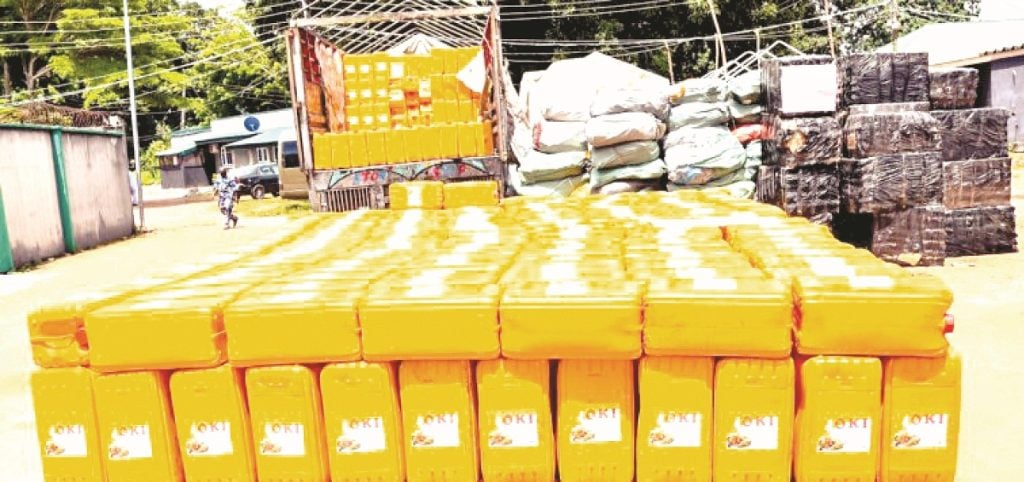
Afeni also disclosed that his command has recorded repeated seizures of vegetable oil, including a major interception of a DAF truck carrying not less than 2,185 kegs along the Shagamu Interchange-Ogere axis.
According to the Acting CAC, no fewer than 12,271 kegs of vegetable oil have been intercepted and seized by officers and men of Ogun 1 Area Command since he took the reins of administration. Apart from massive revenue loss, there is increasing strain on cheaper locally produced ones.
The Customs Chief warned that the influx of foreign vegetable oil into the country is creating a ripple effect of negative consequences that demands immediate attention.
Afeni’s assertions were collaborated by stakeholders in the maritime industry who averred that unchecked smuggling weakens domestic manufacturing, discourages investments and leads to job losses across agricultural value chains, among other grave economic implications.
It is not only drugs, food and petroleum products that smugglers in the country have devised sundry means of smuggling into the country through the Idiroko border corridor. The Ogun 1 Area Command recently made some seizures of pharmaceutical products. In the last count, not less than 77 cartons of Analgin injections without NAFDAC registration numbers, alongside expired seasoning cubes and other unregulated food products were intercepted by officers and men of the command. To say the least, these latest seizures show that Nigeria’s porous borders expose Nigerians to counterfeit medicines and unsafe food items which are injurious to their health and well-being.
In the same vein, officers and men of NCS, Ogun 1 Area Command also intercepted no fewer than six live pangolins in one of their operations recently. Maritime Bits checks revealed that pangolins are among the most trafficked mammals across the globe. This is not unconnected with the high demand for their scales in illegal wildlife markets around the world, especially in Asia.
Afeni has continued to change the tactics and strategies of enforcement since he was appointed the Acting CAC, Ogun 1, Area Command by the Comptroller General of Customs (CGC), Dr. Bashir Adewale Adeniyi. He has continued to stress what he called “intelligence-led enforcement over conventional patrol operations”, in the discharge of his mandate. This entails the deployment geospatial surveillance tools and digital tracking systems which is a key component of the NCS modernisation agenda since Adeniyi’s appointment as CGC by President Tinubu over two years ago.
Joining Forces
The NCS has continued to join forces with other organisations to ensure that it deliver on its core mandate. This has led to the attainment of tangible results in all ramifications, especially in revenue generation. For instance, the command made N125.43 million in revenue from baggage assessment and auctioned petroleum products alone within the period under review. The idea of joining forces with others emanated from the realization that the NCS cannot do it alone. To this end, Afeni has hailed sister agencies, including the National Drug Law Enforcement Agency (NDLEA), Directorate of State Services (DSS), Nigeria Immigration Service (NIS) and the Nigeria Police Force (NPF), for joining forces with the service in the discharge of its roles and responsibilities. He commended them for their support and co-operation over the years.
Last Line
It must be noted that in spite of the meaningful efforts made by NCS, Ogun 1 Area Command in recent times, smugglers and criminals along the Idiroko corridors are adopting novel methods to evade the prying eyes of its officers and men. It remains to be seen whether they will escape the long arms of the law as Afeni and his men are on the offensive to bring them to book no matter how long it takes or what it takes to do so.