

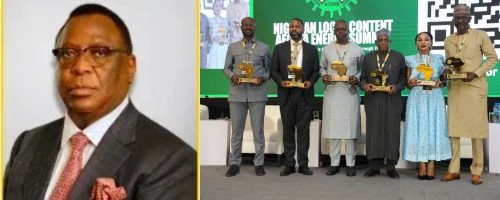
The Executive Secretary, Nigerian Content Development and Monitoring Board (NCDMB), Engr. Felix Omatsola Ogbe has disclosed that Nigeria’s oil and gas industry embraced the African Continental Free Trade Agreement (AfCFTA) and developed a framework for its domestication in 2022.
Ogbe’s revelation was contained in his keynote address at the 2026 edition of AfCFTA) summit which took place in Nigeria’s commercial centre, Lagos recently.
The summit which was attended by regulatory agencies, project promoters, and financial institutions focused on deepening intra-Africa trade, a unified code of standards for professional qualifications and manufactured goods and expansion of the frontiers of technological development and innovation.
Ogbe who was represented by NCDMB Director, Corporate Services, Dr. Abdulmalik Halilu stated that implementing AfCFTA in the industry was anchored on three broad pillars, namely, opportunities identification, capacity development, and capacity exportation.
As regard to opportunities, he said Nigeria’s strength lies in formidable supply chain in oil field services, refining capacity, oil field logistics base, gas supply pipelines, and a pool of qualified oil field technical workforce.
On capacity development, he pointed out that Nigeria’s oil and gas industry, through the local content law, has developed capabilities in the oil and gas value chain spanning marine vessel asset ownership, fabrication, assembly and installation of production systems, including Christmas trees, pressure vessels, and pumps.
According to him, what remains unresolved, is “the next frontier and the reason for convening the summit,” is capacity exportation.
The NCDMB helmsman posited that consideration for a unified work permit and visa that would enable, say, “a welder in Senegal to be engaged in Arlec Engineering Works, Johannesburg, South Africa, for fabrication of heat exchangers, storage tanks, pressure tanks, pressure vessels, and so on.”
In examining the importance of achieving continental economic integration, Ogbe explained that strong regional supply chains would shift Africa from exporting raw materials to producing high-value goods.
For pathways to integration, he listed regional value chains, infrastructure connectivity, regulatory harmonization, industrial clusters, and small and medium scale enterprises (SME) inclusion.
He used the event to assure industry stakeholders and participants of NCDMB maximum support.
Among other things, the summit took a critical look at some of the questions begging for answers.
These include how AfCFTA’s 1.4 billion population and $3.4 trillion economy could achieve “a strategic shift from fragmented economies towards a globally competitive supply chain system”; how Africa could leverage its vast mineral resources, including copper, iron ore, petrochemical, for domestic production of hardware such as Christmas tree (an assembly of valves, fittings on top of a wellhead to control oil production), and how, hypothetically, Tema Shipyard in Ghana could be designated the vessel construction, assembly and repairs hub for Africa.
Related questions were how cables manufactured in Nigeria, hypothetically, could benefit from favourable trade terms in Angola; what compliance requirements a sacrificial anode producer in Nigeria would have to meet in regard to the rule of origin requirement to export anodes to Algeria for protection and longevity of pipelines, storage tanks, offshore platforms, etc., and what other support levers would be required to achieve energy security for Africa besides expanded refining capabilities in Dangote Refinery, laying of continental gas transmission pipelines, and establishment of industrial parks and other support infrastructure.