
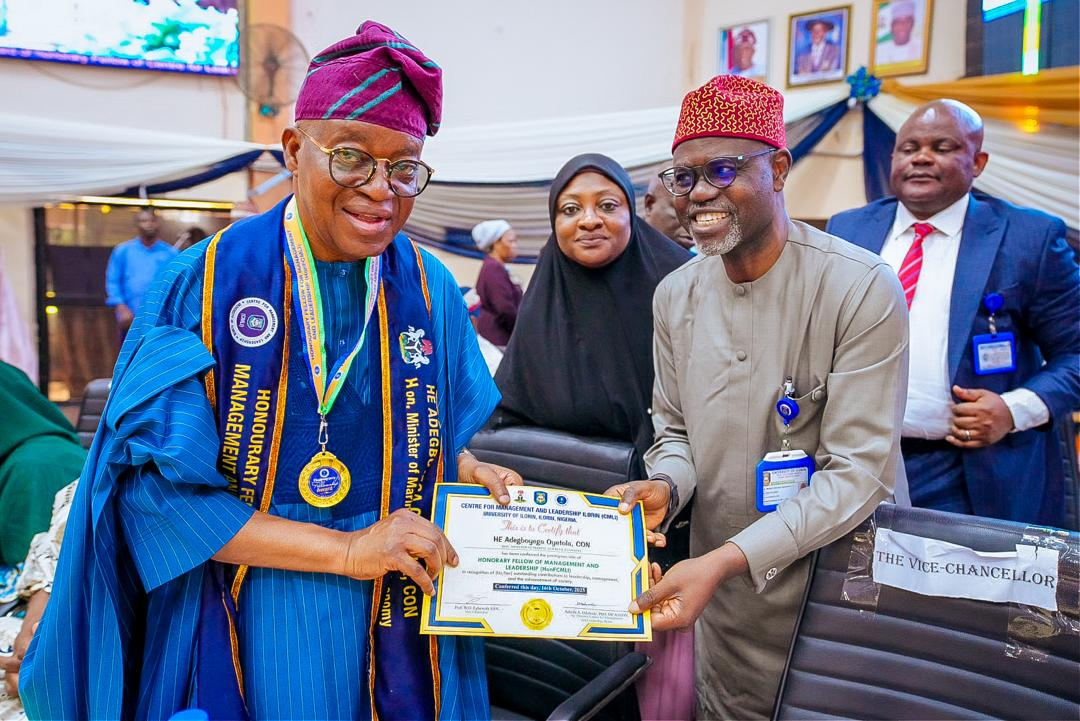
The University of Ilorin has conferred a Honourary Fellow of the Centre for Management and Leadership on the Minister of Marine and Blue Economy, Alhaji Adegboyega Oyetola in recognition of his exceptional contributions to national development, public service, and visionary leadership.
The conferment took place at UNILORIN auditorium during its first distinguished lecture and conferment of award ceremony organised by its Centre for Advancement.
The Governor of Kwara State, Mallam AbdulRahman AbdulRazaq also received an Honorary Fellowship at the event which was attended by dignitaries including representatives of the Kwara State Government, traditional rulers, members of the University Governing Council, the Vice-Chancellor, principal officers, academics, and students.
These were contained in a statement signed by the Special Adviser to the Minister on Media and Communications, Dr. Bolaji Akinola.
According to the statement which was made available to Maritime Bits, the ceremony also featured the unveiling of the Adegboyega Oyetola Centre for Blue and Regenerative Economy, established by the university to promote research, innovation, and sustainable development in Nigeria’s maritime sector.
The centre was named in honour of Oyetola for his role in advancing the nation’s blue economy agenda.
Delivering the maiden distinguished lecture titled “The Nexus Between Blue Economy and Higher Education for Sustainable Development in Nigeria,” Oyetola described the blue economy as a transformative pathway for sustainable national growth, driven by the responsible use of ocean, sea, and inland water resources.
He explained that Nigeria’s 853-kilometre coastline and rich network of waterways hold enormous potential for economic diversification, job creation, and food security, provided that the country invests in education, innovation, and strong governance.
According to Oyetola who was hitherto the governor of Osun State, the blue economy goes beyond exploiting marine resources—it integrates economic prosperity with environmental sustainability and social inclusion.
He noted that sectors such as maritime transport, fisheries, aquaculture, coastal tourism, marine biotechnology, and renewable ocean energy can significantly contribute to Nigeria’s GDP if harnessed effectively.
Oyetola emphasised that higher education plays a central role in unlocking this potential by equipping Nigerians with the technical skills and research capacity needed to drive growth in the maritime sector.
He called on universities to align their curricula with industry demands, foster interdisciplinary research, and strengthen collaboration with government and private sector partners.
He revealed that ongoing reforms in the Ministry of Marine and Blue Economy had led to a remarkable increase in sectoral revenue which rose from ₦700.79 billion in 2023 to ₦1.39 trillion in 2024, achieved through improved efficiency and transparency rather than tariff hikes.
This, he said, demonstrates the impact of sound policy direction, enhanced inter-agency coordination, and accountability-driven governance.
Highlighting key initiatives under his leadership, Oyetola said the Ministry is investing in capacity development through programmes such as the National Seafarers Development Programme (NSDP) which trains 1,000 youths annually for careers in the maritime industry.
He also spoke about the Federal Government’s commitment to modernising port infrastructure, developing new deep-sea ports across Nigeria’s coastal states, and expanding aquaculture and fisheries to promote food security and reduce reliance on imports.
The Minister reiterated that public–private collaboration remains central to Nigeria’s blue economy strategy, citing the success of the Lekki deep seaport and ongoing partnerships to establish additional ports in Akwa Ibom, Bayelsa, Cross River, Ondo, and Rivers States.
He said these projects will not only boost trade and logistics efficiency but also create thousands of jobs and attract significant foreign investment.
He commended UNILORIN for its forward-looking vision in establishing the Centre for Blue and Regenerative Economy, describing it as a milestone in linking academic research with national development.
He assured UNILORIN of his ministry’s full support to ensure the centre achieves its objectives of promoting sustainable marine management, policy innovation, and youth capacity building.
The Vice-Chancellor of UNILORIN, Professor Wahab Olasupo Egbewole, SAN, had earlier in his remarks congratulated Oyetola and AbdulRazaq on their awards, noting that the university was proud to recognise individuals whose leadership has significantly advanced governance, education, and sustainable development in Nigeria.
The highpoint of the occasion was the formal unveiling of the Adegboyega Oyetola Centre for Blue and Regenerative Economy which is expected to serve as a hub for research, innovation, and collaboration in the sustainable management of Nigeria’s marine and coastal resources.