
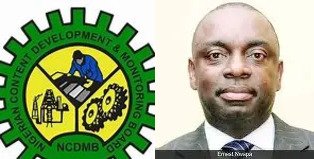
Oil industry investments in Nigeria is not stifled by local content, the pioneer Executive Secretary, Nigerian Content Development and Monitoring Board (NCDMB), Dr. Ernest Nwapa has said.
He dismissed the notion that the absence of final investment decisions (FIDs) in the country’s oil and gas sector over a period of time was caused by stringent implementation of local content policies by NCDMB.
He averred that there are many government policies that are affecting FIDs over the years.
Nwapa stated this in a paper he presented at the Nigerian Content Academy lecture series organised by NCDMB recently.
Speaking on the topic “Staying the Nigerian Content Course in the Midst of Delivery Challenges,” he used the occasion to address several industry issues plaguing the oil and gas industry over the years.
He however admitted that the oil and gas industry stakeholders face what he called “an increasingly complex environment shaped by global energy trends, shifting investment patterns and heightened expectations for local participation and value addition.”
On suggestions that the future of local content policies is under intense scrutiny, Nwapa, a one-time Group General Manager, Nigerian Content Division, Nigerian National Petroleum Corporation (NNPC) from 2005 to 2010 noted that such unfounded fears had always been advocated by some industry stakeholders averse to the idea of local content.
The pioneer NCDMB boss drew attention to some unhealthy trends in the oil and gas industry, noting that “there are unintended ambiguities in the Presidential Directives” introduced in February 2024.
Such ambiguities, he pointed out, need to be addressed by stakeholders. He regretted that the ambiguities in the Presidential Directives have created systemic problems, and that there has to be “institutional adjustment to re-enact the authority in the NCDMB directives.”
He decried what he described as “lack of respect for the authority of the NCDMB within some industry stakeholder groups,” arguing that “when the Board writes a letter and says this is what stands on Nigerian Content, nobody questions it.”
According to him, if you challenge a letter from the NCDMB, it would not stand. It is wrong for any agency to put aside a letter from the Board and continue doing things in its own way.
Nwapa, a fellow of the Nigerian Society of Engineers (FNSE), pointed out that Nigerian content has been a national aspiration with mixed results since the Nigerian economic development model was conceived.
He argued that statutes like the Petroleum Act, 1969, the Joint Venture (JV) agreements, the Petroleum Technology Development Fund (PTDF), and creation of NAPIMS, all had been conceived to achieve some measure of local content.
According to the former NCDMB helmsman, there was also the Coastal and Inland Shipping (Cabotage) Act, 2003. But all these were incomparable to the Nigerian Oil and Gas Industry Content Development (NOGICD) Act, 2010.
Continuing, he said: “Our young engineers, our young technicians now have places to go to acquire practical skills because a lot of projects are going on in the country. If you look at the number of Nigerians that worked in Egina at the Integration Yard (SHI-MCI Fabrication and Integration Yard, Tarkwa Bay, Lagos), it is not something you can just underestimate. So we need to know there are serious consequences for failure of what we’ve started.
“Things around high costs of local content are things that we have to continue to work on to see how we can have them reduced. If you do not start practising local content and get your people involved, the costs gap will be wider and wider. So it is either you decide to bite the bullet right now and use activities within your local economy to drive the costs to competitive levels or you can forget about it and not do it at all.”
Nwapa advised that cost of projects needs to be evaluated on a project-by-project basis and handled strategically by the Board even as he insisted that “NCDMB has “the power to do that, working with the industry players,” who would provide the information and matrices.
He also advised that the Nigerian Content Academy, a division of the NCDMB, should be “a place where we test theories, and we go outside to the field and have strong workshop discussions and analysis, and proffer practical recommendations,” which could be taken to the NCDMB Executive Secretary or right up to The Presidency.
When the moderator of the lecture series and Director of the Academy, Dr. Ama Ikuru invited questions and comments from participants, Mr. Simeon Ogari, Nigerian Content Manager of SEPLAT Energy Limited, sought to know why there is Nigerian Oil and Gas Industry Content (NOGIC) Joint Qualification System (JQS) and a parallel JQS operated by Nigerian Petroleum Exchange (NIPEX). Nwapa said the situation had been so for some time but that it has not disrupted industry activities and that differences could be sorted out in time.
Other participants who sought clarifications include Mr. Isoboye Amachree of Oando Plc, Mr. Kamselem Mohammed and Barrister Naboth Onyesoh, NCDMB Director of Legal Services.
The Nigerian Content Academy lecture series hold weekly and are intended to raise awareness of trends and issues in the oil and gas industry, and thus empower Nigerians to take full advantage of economic opportunities in that sector.