
In order to unlock the economic potentials of the oil and rich Delta State, state governor, Right Hon. Sheriff Oborevwori has called on the Federal Government to resuscitate the seaports located in the state.
These seaports include the ones situated in Warri, Koko, Sapele, and Burutu which is a shouting distance to the Atlantic Ocean.
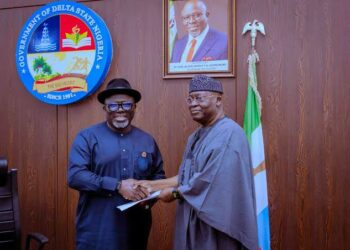
Oborevwori who made the call when the Board of Directors of the Nigerian Ports Authority (NPA), led by its Chairman, Senator Adedayo Adeleye called on him at Government House, Asaba recently reiterated the readiness of his administration’s commitment to collaborate with the Federal Government to effectively revive the four seaports in the state to unlock the full economic potentials.
The governor averred that the revitalization of the ports would create jobs, attract investments and boost national revenue.
His words: “Delta State is strategically blessed with four seaports. If these ports are revived, they will create massive employment, stimulate trade, and strengthen the economy of the state and Nigeria. It is often more impactful to modernize existing ports than to build new ones”.
Oborevwori used the occasion to hail NPA for its modernization efforts just as he appealed for what he called “urgent dredging” of Warri Channel and the rehabilitation of Warri and Koko port facilities.
He argued that such interventions needed to be treated as national priorities even he disclosed that the state government was working closely with the Federal Government to tackle critical infrastructural challenges.
His words: “The Federal Government has awarded the Summit Junction–Bridge Head section of the Benin-Asaba Highway to Heartland Construction Company (HCC) while the State Government has awarded a section of the Sapele–Warri Road project to CCECC at a cost of N35 billion. This is a clear demonstration of the positive relationship between the state and the centre.”
He assured potential investors of improved security in the state, noting that oil installations were no longer under frequent attacks and that the environment was now peaceful for business.
The governor also revealed that the state government had enacted a law against collection of illegal levies and harassment of companies to protect investments.
The Delta State number one citizen who recently decamped from the Peoples Democratic Party (PDP) on which platform he ran and won the governorship of the state to the ruling All Progressives Congress (APC) enjoined companies operating in the state to honour their Memoranda of Understanding (MOUs) with host communities by engaging local people.
He argued that this was a genuine strategy to sustaining harmony between the companies and their host communities.
He also highlighted ongoing projects, adding that Julius Berger had returned to the state for the first time in years, handling major flyover projects at PTI Junction, Enerhen Junction, and DSC Roundabout, among others.
According to him, Delta State is open for business, ready for partnership, and determined to consolidate its position as Nigeria’s leading maritime and economic hub.
Adeleye had earlier in his opening remarks pledged the Board’s readiness to work closely with the Delta State Government to revive the ports in the state and enhance their contribution to Nigeria’s maritime economy.
The NPA Board Chairman told Oborevwori that the ports located in the state, namely Warri, Koko, Sapele, and Burutu were strategic gateways that, if fully optimized, would boost trade, create jobs, and drive economic growth.
He noted that the NPA Board, inaugurated in June by the Minister of Marine and Blue Economy, Alhaji Adegboyega Oyetola embarked on a nationwide tour of ports to assess challenges firsthand before implementing solutions.
He applauded the Delta Government for supporting security around the ports, stressing that safety remained crucial to sustaining operations.
He also highlighted issues of underutilization, collapsed quays, shallow channels, and the need for a deep seaport to attract global shipping traffic.
Adeleye’s words: “Delta ports currently contribute about 10.7 percent of national trade volumes, which is impressive, but there is room for improvement. With stronger collaboration, we can restore the vibrancy of these ports and strengthen Nigeria’s maritime trade.”
He acknowledged the state government’s role in fostering cordial relations with host communities and implementing corporate social responsibility (CSR) initiatives to sustain peace.